
In this post, I will start by presenting some famous optimization algorithms. In a second step, I will give some interesting connections between them, allowing the reader to get a better understanding of the field.
I. Greedy methods
II. Primal methods
- Gradient descent
In this section, we consider a function  , that is differentiable and convex, and we tackle the problem:
![\[ \min_{x \in \mathbb R^d}f(x).\]](https://quentin-duchemin.alwaysdata.net/wiki/wp-content/ql-cache/quicklatex.com-f13c718a65970d4f5253da2a4840973b_l3.png "Rendered by QuickLaTeX.com")
 . Suppose we are
provided with an initial point
 . Then the gradient descent algorithm is:
 ![\[ x_{k+1}:= x_k - \gamma_k \nabla f(x_k),\]](https://quentin-duchemin.alwaysdata.net/wiki/wp-content/ql-cache/quicklatex.com-9d1f85a7a7ad98a9a5eb8ec7c8871d5f_l3.png "Rendered by QuickLaTeX.com")
 is a step size to be tuned. The interpretation of the gradient descent method is minimizing a local quadratic approximation
of
: ![\[ f(x) \approx f(x_k)+\nabla f(x_k) ^{\top}( x-x_k) + \frac{1}{2\gamma_k} \|x-x_k\|^2_2.\]](https://quentin-duchemin.alwaysdata.net/wiki/wp-content/ql-cache/quicklatex.com-c33b296b2a97823a4147d83fb771564f_l3.png "Rendered by QuickLaTeX.com")
where
is unknown a priori. However, there are several manners to choose the step size . The first one is to consider it constant. In this case, we require to be gradient Lipschitz in order to ensure convergence. Another way to choose the step size is to perform an adaptive and local computation, called a line search. One example is the so-called backtracking line search, also know as Armijo’s rule.
| Drawbacks | Advantages |
| Often slow | Each iteration has small cost |
| needs to be differentiable | It is a first order method |
- To address the first issue, methods to improve convergence are:
quasi-Newton methods – conjugate gradient method – accelerated gradient method. - To address the second issue, methods for nondifferentiable or constrained problems are:
subgradient method – proximal gradient method – smoothing methods – cutting-plane methods.
2. Quasi-Newton
The Newton method comes from minimizing a second-order approximation of around
![\[f(x) \approx f(x_k) + \nabla f(x_k) ^{\top} (x-x_k) + \frac12 (x-x_k)^{\top} \nabla ^2 f(x_k) (x-x_k),\]](https://quentin-duchemin.alwaysdata.net/wiki/wp-content/ql-cache/quicklatex.com-caf9f1ccd235383969ca13ca91754a06_l3.png "Rendered by QuickLaTeX.com")
leading to the update rule
![\[x_{k+1} = x_k - \left(\nabla ^2f(x_k) \right)^{-1} \nabla f(x_k).\]](https://quentin-duchemin.alwaysdata.net/wiki/wp-content/ql-cache/quicklatex.com-daca9bd942fef3b6a19df9db60671679_l3.png "Rendered by QuickLaTeX.com")
If the Newton method demonstrates fast convergence, it has the disadvantage to be expensive for large scale applications. To overcome that, the Hessian can be approximated by a metric
 , that is symmetric positive definite.
Hence, the Quasi-Newton methods differ by considering different way to compute the sequence of matrix
 . One of the most famous Quasi-Newton method is the Broyden-Fletcher-Goldfarb-Shanno (BFGS) method.
3. Subgradient method
From now on, we no longer require to be differentiable (but is still convex). Subgradient method is certainly the simplest method for minimizing . It is similar to gradient descent but replacing gradients by subgradients.
![\[x_{k+1} = x_k - \gamma_k v_k,\]](https://quentin-duchemin.alwaysdata.net/wiki/wp-content/ql-cache/quicklatex.com-d6fb6f2d1b5126eddcb912a8b03c4c2f_l3.png "Rendered by QuickLaTeX.com")
where
 and is the step size.
Remark : Contrarily to a negative gradient  , a negative subgradient
  is not a direction of descent in general. This means that the subgradient method is not a descent method (
 can occur).
4. Proximal gradient method
Optimization problems in machine learning are often of the form:
![\[ \min_{ x \in \mathbb R^d} f(x) + g(x),\]](https://quentin-duchemin.alwaysdata.net/wiki/wp-content/ql-cache/quicklatex.com-6830959a3789352ed1ac2cf0f34d9d68_l3.png "Rendered by QuickLaTeX.com")
where
 is a differentiable and convex function and
 ![g : \mathbb R^d \to (-\infty,+\infty]](https://quentin-duchemin.alwaysdata.net/wiki/wp-content/ql-cache/quicklatex.com-8e4582a434c205b8a5958c3347a08380_l3.png "Rendered by QuickLaTeX.com") is a convex function. In this section, we leverage the special structure of this problem to introduce fast
is a convex function. In this section, we leverage the special structure of this problem to introduce fastalgorithms (compared to subgradient methods) even though the global function
 is not differentiable.
Definition (Proximal operator). Let ![h: \mathbb R^d \to [-\infty,+\infty]](https://quentin-duchemin.alwaysdata.net/wiki/wp-content/ql-cache/quicklatex.com-2824076ea1cd408df1601ae0fb5c41c4_l3.png "Rendered by QuickLaTeX.com") be a proper, lower semi-continuous convex function. The proximal operator of
be a proper, lower semi-continuous convex function. The proximal operator of  is defined by:
![\[ \forall x \in \mathbb R^d, \quad \mathrm{prox}_h (x) = \arg \min_{ u \in \mathbb R^d} \; f(u) + \frac12 \|x-u\|^2_2.\]](https://quentin-duchemin.alwaysdata.net/wiki/wp-content/ql-cache/quicklatex.com-a7ef21f52b3074efb935c00a1290e76b_l3.png "Rendered by QuickLaTeX.com")
(By strong convexity, the arg min exists and is a singleton, so proxg is well defined.)
The following algorithm is workable in the setting described previously, that is when:
 is convex and differentiable;
- is convex with an easy-to-compute proximal operator.
![\[x_{k+1} = \mathrm{prox}_{\gamma_k g}(x_k - \gamma_k \nabla f(x_k),\]](https://quentin-duchemin.alwaysdata.net/wiki/wp-content/ql-cache/quicklatex.com-26bb435000cde54737c4e250d3b3c206_l3.png "Rendered by QuickLaTeX.com")
where
is a step size.The interpretation of the proximal gradient method is very similar to the one of the gradient descent. It consists in minimizing a local quadratic approximation of plus the original non-differentiable function  :
:

where
is unknown a priori.
5. Douglas-Rachford method
Here, we focus on the optimization problem:
![\[ \min_{x \in \mathbb R^d} f(x) + g(x),\]](https://quentin-duchemin.alwaysdata.net/wiki/wp-content/ql-cache/quicklatex.com-cf106bc3285cb9b7f65ef01e223bc014_l3.png "Rendered by QuickLaTeX.com")
where
![f :\mathbb R^d \to (-\infty,+\infty]](https://quentin-duchemin.alwaysdata.net/wiki/wp-content/ql-cache/quicklatex.com-102e108393cea113ecdbe282a0e15b64_l3.png "Rendered by QuickLaTeX.com") and
and ![g :\mathbb R^d \to (-\infty,+\infty]](https://quentin-duchemin.alwaysdata.net/wiki/wp-content/ql-cache/quicklatex.com-62d8fde7799285be7d603f4942ce0541_l3.png "Rendered by QuickLaTeX.com") are two convex functions. Contrarily to the proximal gradient method, the Douglas-Rachford does not require f to be differentiable. Starting from an initial point
are two convex functions. Contrarily to the proximal gradient method, the Douglas-Rachford does not require f to be differentiable. Starting from an initial point  , the Douglas-Rachford algorithm reads:
where
 is a step size and
  .
.
| We can derive three special cases of the proximal gradient method: – when  , the proximal gradient method is a gradient descent; , the proximal gradient method is a gradient descent;– when  for a set for a set  , the proximal method is a projected gradient descent; , the proximal method is a projected gradient descent;– when  , we get the proximal point method. , we get the proximal point method. |
III. Primal-Dual methods
Let us consider the optimization problem:
minimize

where
![f : \mathbb R^d \to (-\infty, +\infty]](https://quentin-duchemin.alwaysdata.net/wiki/wp-content/ql-cache/quicklatex.com-4fa26153d9730ccb928769fefd665149_l3.png "Rendered by QuickLaTeX.com") and
and ![g :\mathbb R^p \to (-\infty, +\infty]](https://quentin-duchemin.alwaysdata.net/wiki/wp-content/ql-cache/quicklatex.com-268837fafdf80c6cc15bcc3a104d132b_l3.png "Rendered by QuickLaTeX.com") are proper convex and
are proper convex and  . This problem is equivalent to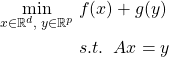
The dual function to this last problem is:
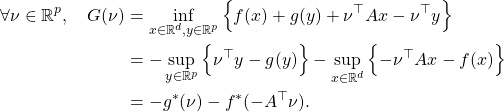
Therefore, the dual problem of interest is:
(1) 
Theorem
Let , ![g : :\mathbb R^p \to (-\infty,+\infty]](https://quentin-duchemin.alwaysdata.net/wiki/wp-content/ql-cache/quicklatex.com-c4adcd72b04fedcea8342d26c611c6c3_l3.png "Rendered by QuickLaTeX.com") be proper convex functions and . Assume that either
be proper convex functions and . Assume that either  or
or  and that
  .
.
If the optima are attained in Problem \eqref{P10} and Problem \eqref{P11}, then strong duality holds:
![\[ \min_{x \in \mathbb R^d} f(x) + g(Ax) = \max_{\nu \in \mathbb R^p}- g^*(\nu)-f^*(-A^{\top}\nu).\]](https://quentin-duchemin.alwaysdata.net/wiki/wp-content/ql-cache/quicklatex.com-5ac264a361135f0f03c7255762239984_l3.png "Rendered by QuickLaTeX.com")
Moreover, a primal-dual optimum is a solution to the saddle-point problem:
![\[ \min{x \in \mathbb R^d} \max_{ \nu \in \mathbb R^p} f(x)+\nu^{\top}Ax-g^*(\nu).\]](https://quentin-duchemin.alwaysdata.net/wiki/wp-content/ql-cache/quicklatex.com-dc439152c48111837faa60643d7fc1a9_l3.png "Rendered by QuickLaTeX.com")
We have seen previously that the proximal gradient method, used for minimizing a composite objective function, reduces to:
- the gradient method when
- the proximal point method when .
In this section, we exploit these two simple algorithms with the dual problem \eqref{P11} to devise primal-dual methods.